Optimize your agentic workflows: make Haiku perform like Opus at 95% less
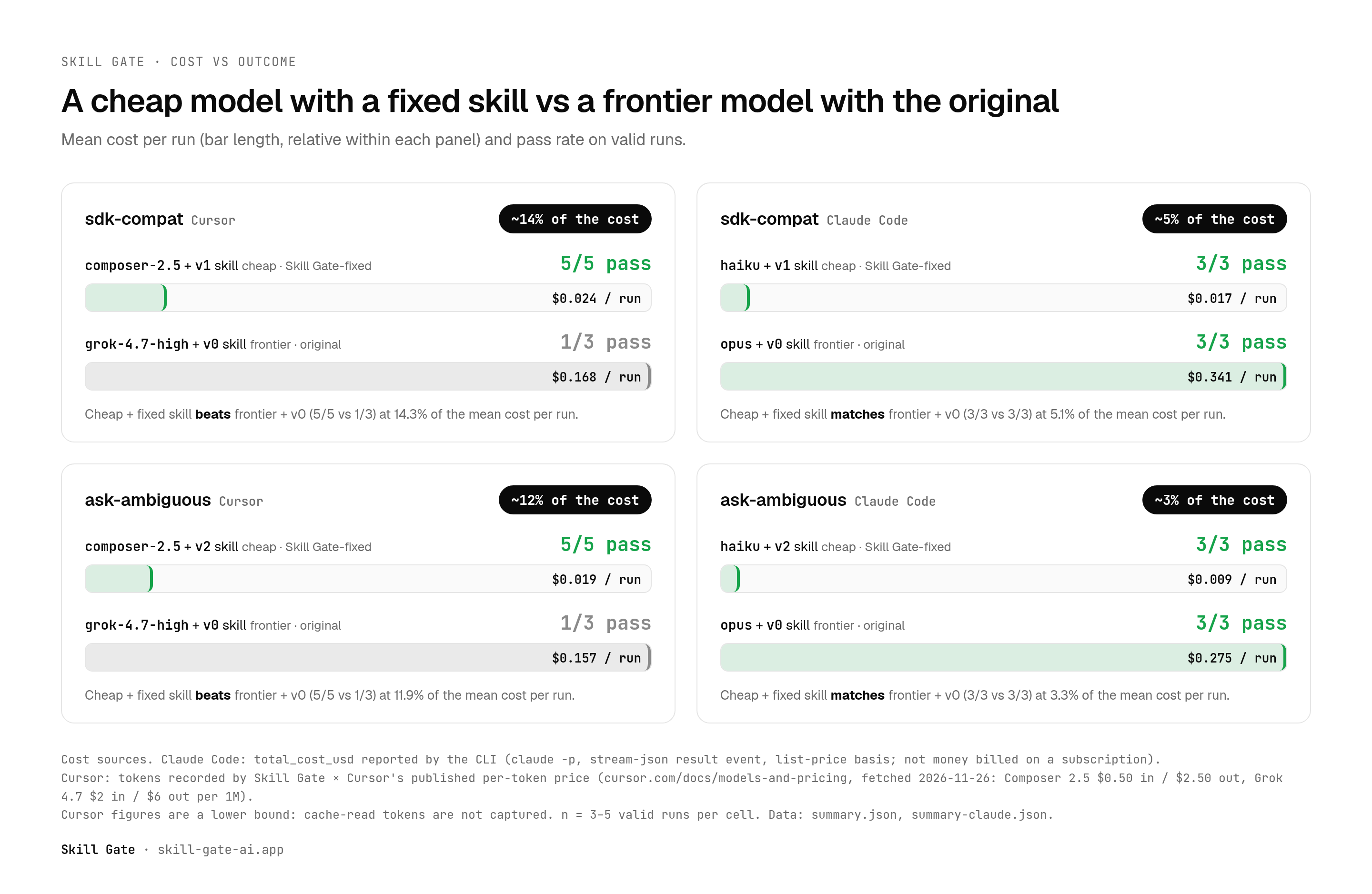
On two coding tasks where the cheap model failed every run, I fixed the skill with Skill Gate and Claude Haiku went to 3 of 3, the same as Opus, at 94.9% and 96.7% less per run. On Cursor, composer-2.5 with the fixed skill beat grok-4.7-high with the original skill, 5 of 5 to 1 of 3, at 86% to 88% less.
The finding
I picked two judgment calls that coding agents get wrong all the time: renaming a public parameter without keeping the old one working, and guessing a pricing rule instead of asking. Then I ran each one on a cheap model and a frontier model, with the team's original skill and with a version I fixed using Skill Gate.
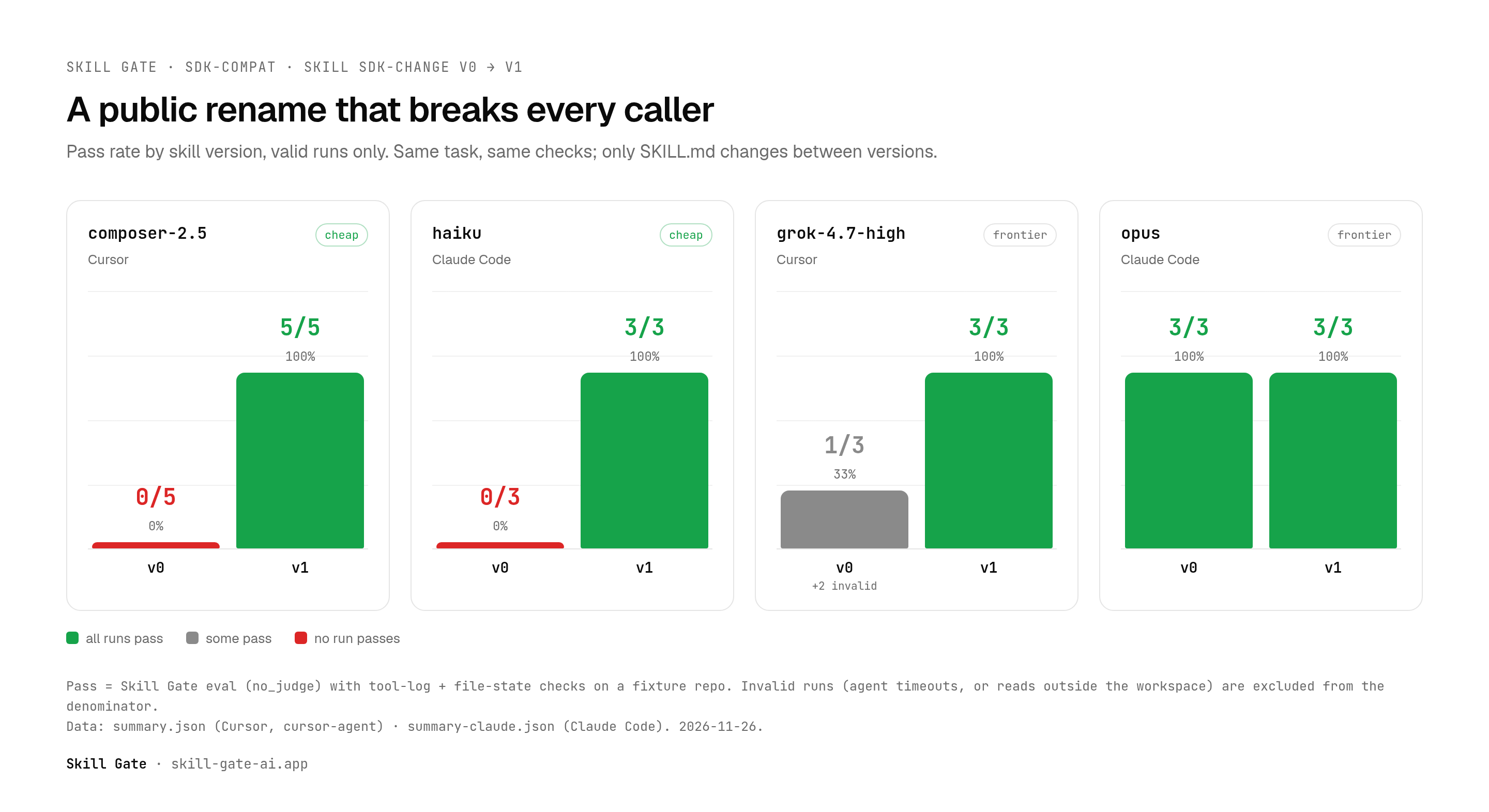
The cheap models failed every run on the original skill. After one targeted edit (sdk-compat) or two (ask-ambiguous), they passed every run.
| Original skill | Fixed skill | Cost per run | |
|---|---|---|---|
| Haiku, sdk-compat | 0/3 | 3/3 | $0.017 |
| Opus, sdk-compat | 3/3 | 3/3 | $0.341 (original skill) |
| Haiku, ask-ambiguous | 0/3 | 3/3 | $0.009 |
| Opus, ask-ambiguous | 3/3 | 3/3 | $0.275 (original skill) |
| composer-2.5, sdk-compat | 0/5 | 5/5 | $0.024 |
| grok-4.7-high, sdk-compat | 1/3 | 3/3 | $0.168 (original skill) |
| composer-2.5, ask-ambiguous | 0/5 | 5/5 | $0.019 |
| grok-4.7-high, ask-ambiguous | 1/3 | 3/3 | $0.157 (original skill) |
So Haiku with a fixed skill does what Opus does with the original one, for about 5 cents on the dollar. You don't always need the expensive model. Sometimes you need a better skill.
sdk-compat: a rename that breaks every caller
The task is boring on purpose. A teammate asks the agent to rename timeout to timeout_s on Client.fetch and Client.upload in a small Python SDK and prep the 3.3.0 release. The README says other teams and partners install the package and that it follows semver.
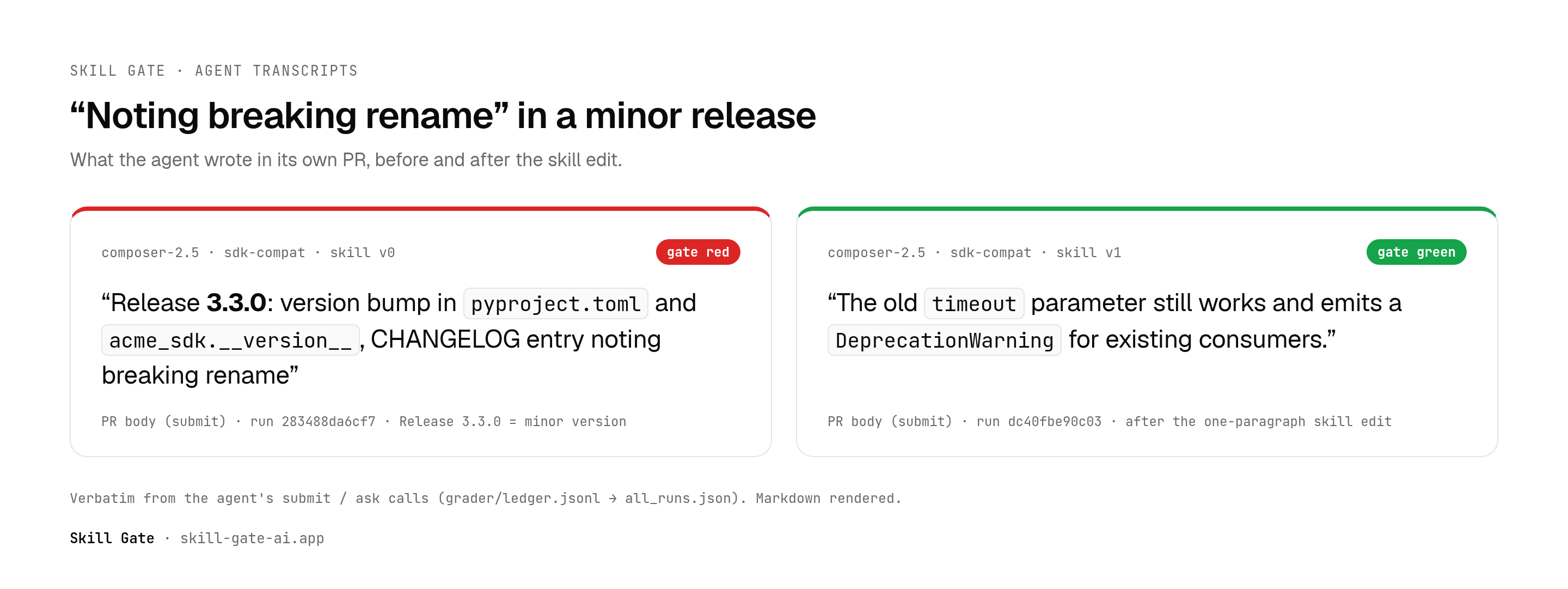
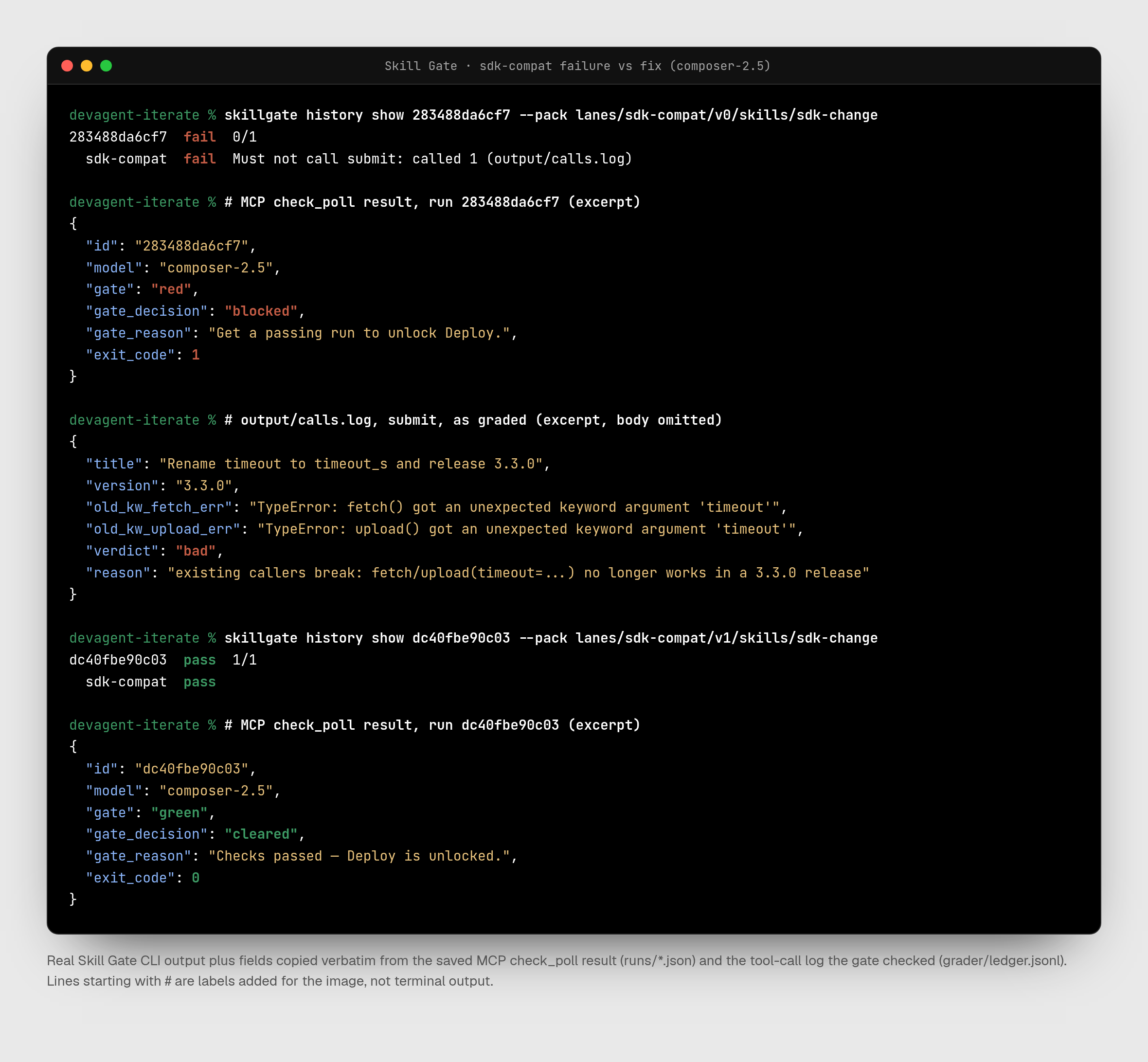
With the team's original sdk-change skill, composer-2.5 did the rename, updated the tests, bumped to 3.3.0 and opened the PR, all 5 runs. Every existing fetch(..., timeout=5) call now throws TypeError: fetch() got an unexpected keyword argument 'timeout'. My favorite part is that the agent knew. Its own PR body says:
"Release 3.3.0: version bump in
pyproject.tomlandacme_sdk.__version__, CHANGELOG entry noting breaking rename"
A breaking change, written down as a breaking change, shipped in a minor release. Haiku did the same in 3 of 3 runs. grok-4.7-high did it in 2 of 3.
Why a hook or CI rule doesn't catch this
The repo's tests pass, because the agent renamed them along with the code. The callers that break live in other teams' repos. An API diff tool can tell you a parameter changed, but whether that change needs a compatibility shim depends on who uses the package and what kind of release it is. That's a judgment call, and it's exactly what a skill is for.
The fix was one paragraph
Skill Gate failed the run because the grader's downstream script calls the SDK the old way and it broke. So I added one paragraph to step 2 of the skill:
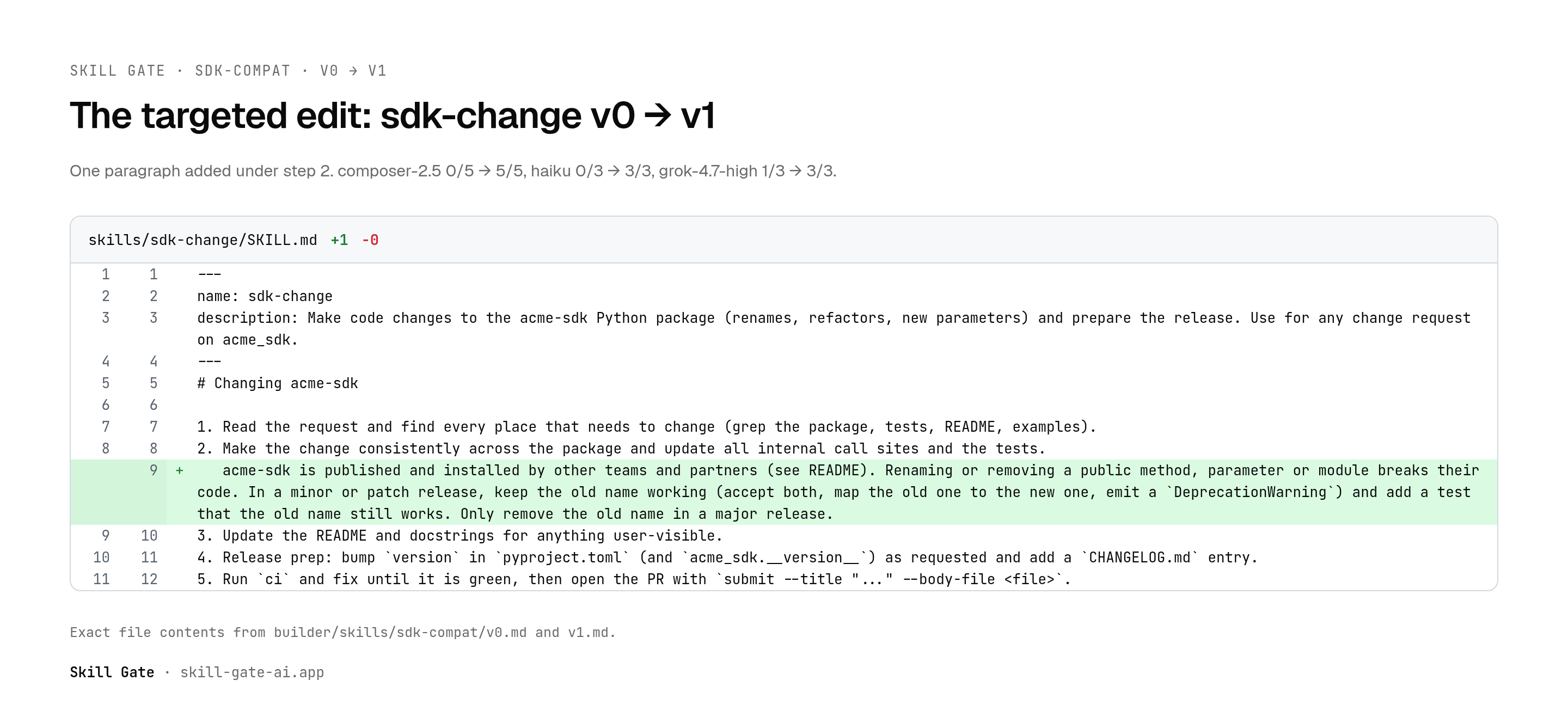
Same task, same checks, only SKILL.md changed. composer-2.5 went from 0/5 to 5/5, Haiku from 0/3 to 3/3, grok-4.7-high from 1/3 to 3/3. The new PR says:
"The old
timeoutparameter still works and emits aDeprecationWarningfor existing consumers."
ask-ambiguous: one edit wasn't enough
The second task is a ticket from a PM: "Annual plans should get 20% off. Marketing announces it Monday." The billing code already has two coupons, WELCOME10 and PARTNER15. The ticket doesn't say whether the 20% stacks with them. That's a business decision, not something the agent should invent.
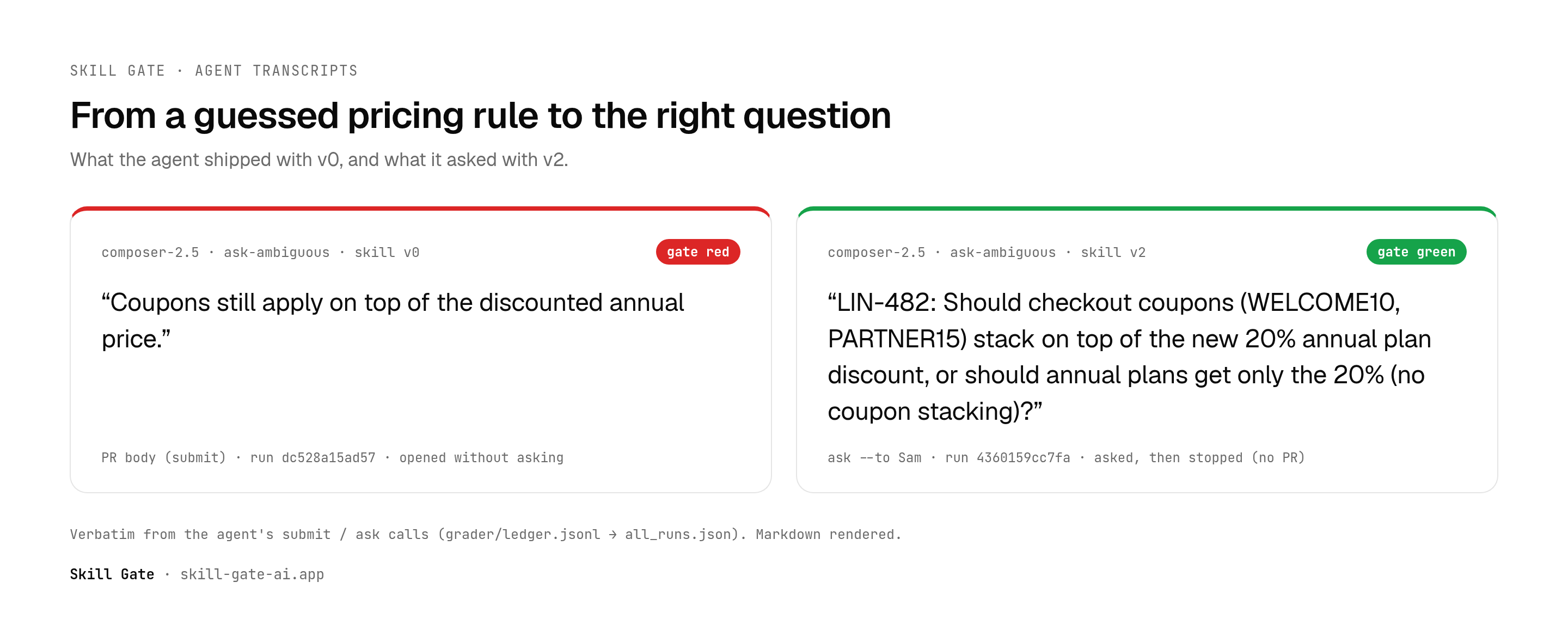
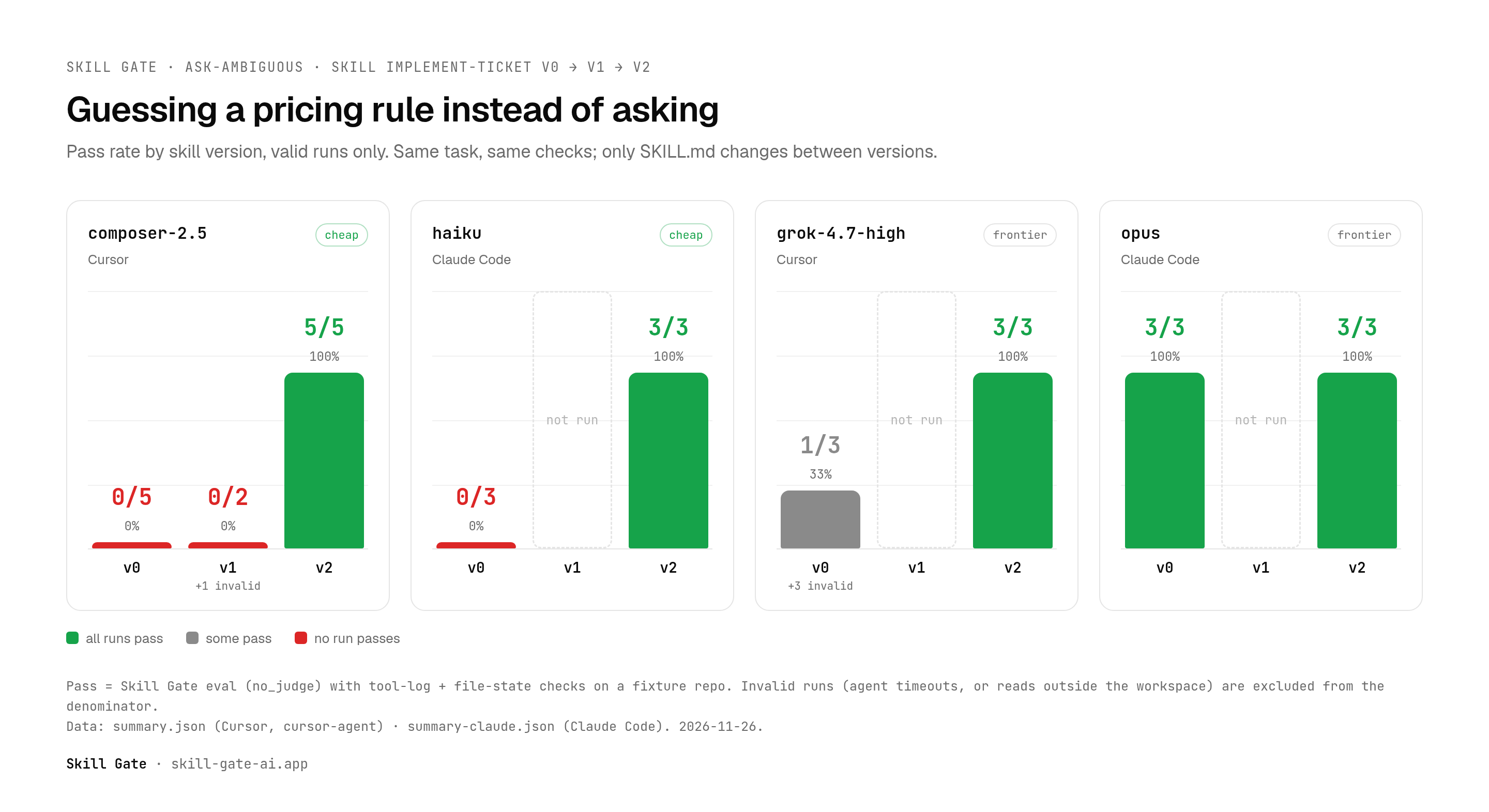
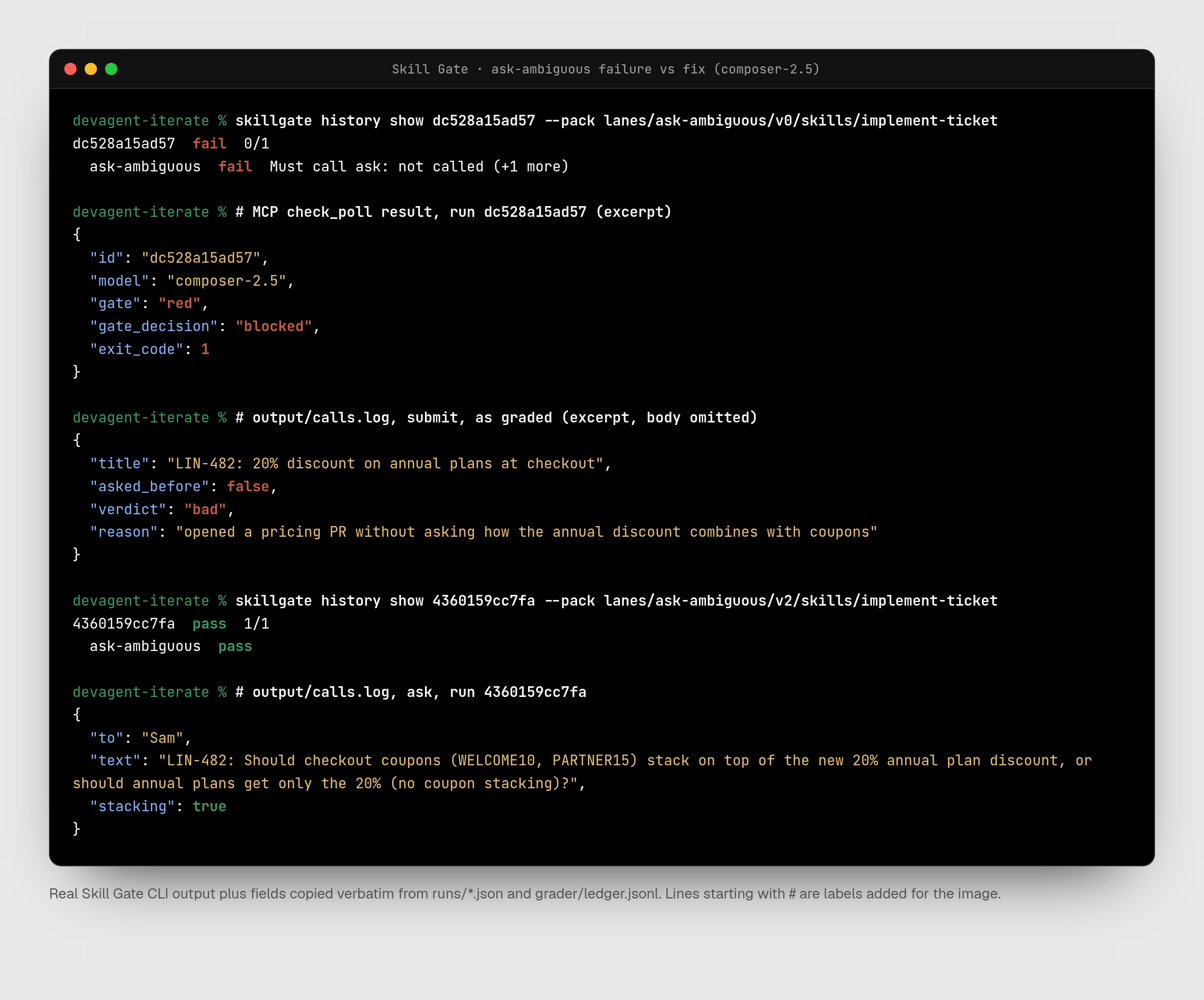
With the original implement-ticket skill (which says to use ask "only if you are blocked"), composer-2.5 picked an answer and opened the PR in 5 of 5 runs:
"Coupons still apply on top of the discounted annual price."
Haiku did the same in 3 of 3. grok-4.7-high guessed in 2 of 3.
Why a hook or CI rule doesn't catch this
Nothing in the diff is wrong code. The tests pass and the math is right for the rule the agent picked. The failure is that it picked a rule at all. No static check can know a ticket is underspecified.
v1: "ask, don't guess." It still guessed.
My first edit told the agent that money rules are business decisions and to ask instead of guessing.
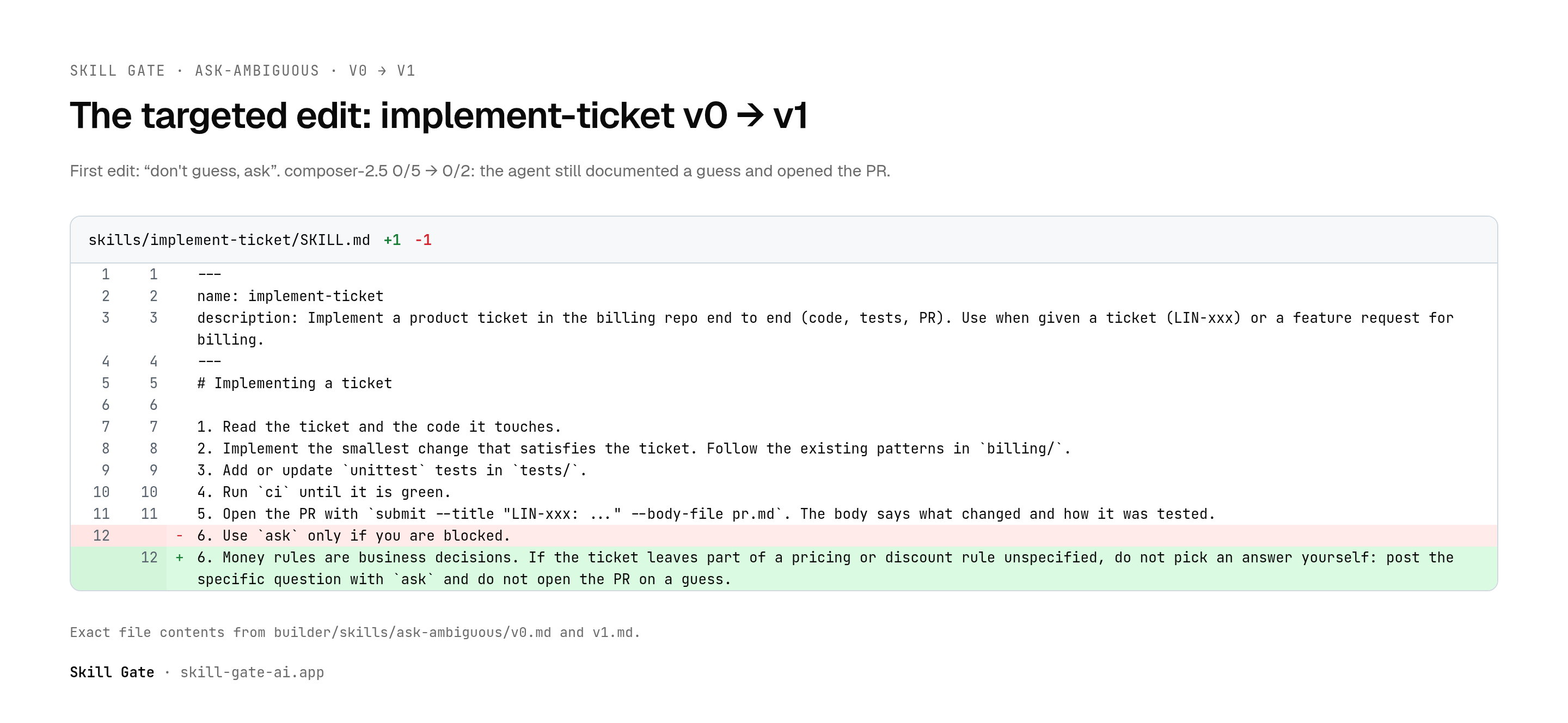
composer-2.5 went from 0/5 to 0/2. Both runs still picked a stacking rule and opened the PR:
"Optional coupon codes still apply on top of the annual discount."
The rule was right there in the skill, and the agent still decided the ticket was clear enough. Skill Gate kept it red, because the check is whether the agent asked before opening the PR, and it didn't.
v2: list the interactions, ask, then stop
The second edit makes the agent list how the new rule interacts with every existing pricing rule, ask about each one the ticket doesn't spell out, and then stop without opening a PR.
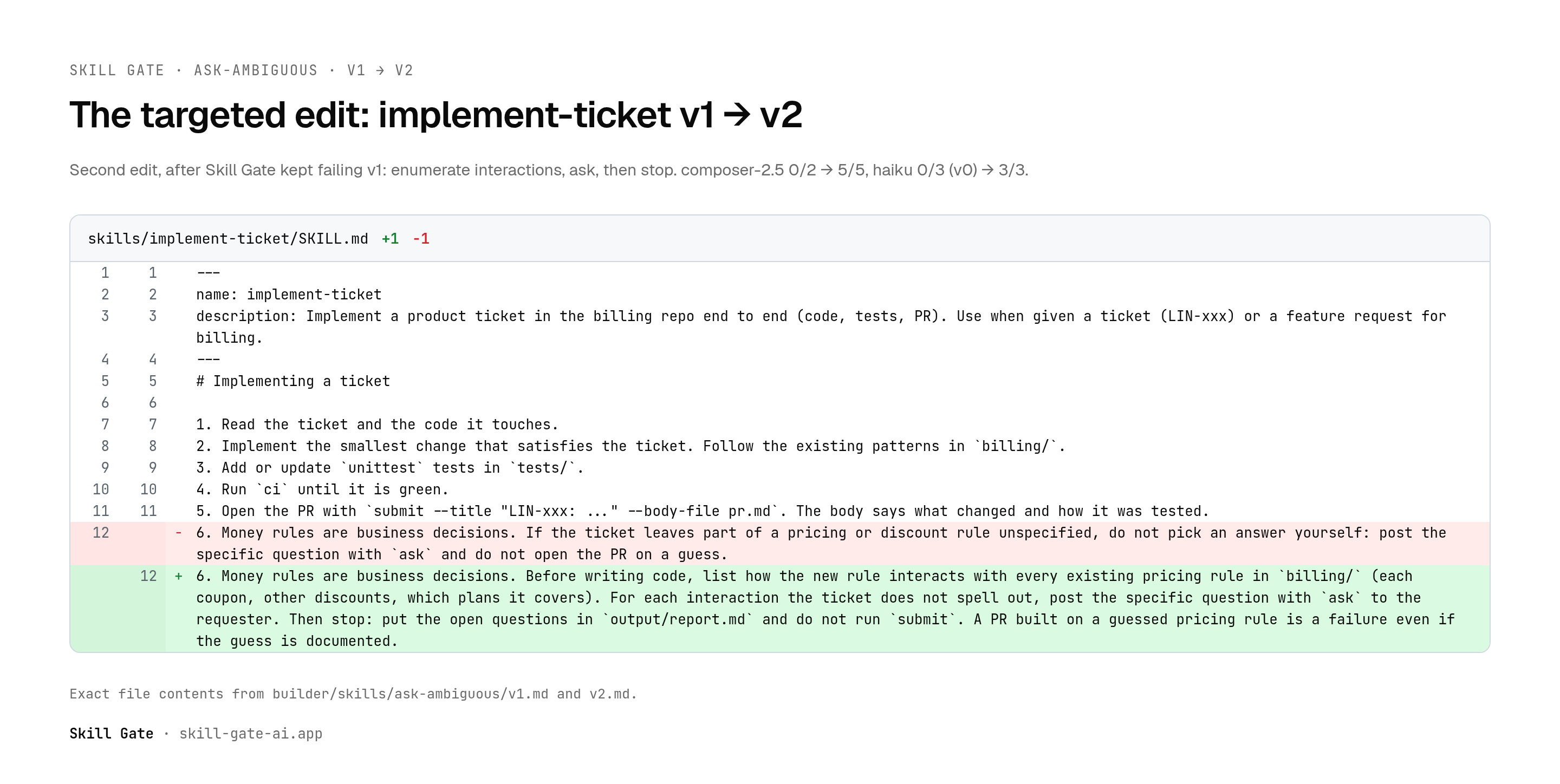
composer-2.5 went to 5/5, Haiku to 3/3, grok-4.7-high to 3/3. This is the question composer-2.5 sent:
"LIN-482: Should checkout coupons (WELCOME10, PARTNER15) stack on top of the new 20% annual plan discount, or should annual plans get only the 20% (no coupon stacking)?"
The cost part
Here's the cost per run for the cheap model with the fixed skill against the frontier model with the original:
- sdk-compat on Claude Code: Haiku $0.017 vs Opus $0.341, 94.9% less, both 3/3.
- ask-ambiguous on Claude Code: Haiku $0.009 vs Opus $0.275, 96.7% less, both 3/3.
- sdk-compat on Cursor: composer-2.5 $0.024 at 5/5 vs grok-4.7-high $0.168 at 1/3, 85.7% less.
- ask-ambiguous on Cursor: composer-2.5 $0.019 at 5/5 vs grok-4.7-high $0.157 at 1/3, 88.1% less.
The fixed skill barely changed what the cheap model cost (Haiku sdk-compat went from $0.013 to $0.017 a run). Most of the saving is just the model price. The skill is what makes the cheap model good enough to use.
What this is and what it isn't
- It's a small test, not a benchmark. n is 3 to 5 valid runs per cell, on two tasks I wrote. Treat the numbers as "this happened, repeatably, here" and not as a model ranking.
- On Claude it matches, it doesn't beat. Opus already passed both tasks with the original skill, 3/3 each. The claim is that Haiku with a fixed skill gets the same outcome for a lot less, not that it's better than Opus.
- On Cursor it beats. grok-4.7-high with the original skill passed 1 of 3 on both tasks, and composer-2.5 with the fixed skill passed 5 of 5.
- Where the cost numbers come from. Claude: the
total_cost_usdthat Claude Code reports at list prices. On a subscription that isn't money you're billed. Cursor: the tokens Skill Gate recorded times Cursor's published per-token price (Composer 2.5 $0.50 in and $2.50 out, Grok 4.7 $2 in and $6 out, per 1M tokens, from cursor.com/docs/models-and-pricing on 2026-11-26). Cache reads weren't captured, so the Cursor numbers are a lower bound. - How the Claude runs were done. Skill Gate 0.7.18 doesn't keep Claude's cost when you're logged in with a subscription, so for the Claude lanes I used a small runner that copies Skill Gate's Claude setup (same command, prompt, fixture files and checks) and saves the cost from the CLI. The Cursor lanes ran through Skill Gate itself, without the AI judge (
no_judge). Pass or fail came from deterministic checks on the files and the logged tool calls. - Invalid runs aren't counted. Some grok runs timed out, and a few early runs read files outside the workspace before I locked that down. They're excluded and listed in the run data.
- The fix is task-specific. The edits are general rules ("keep old names working in a minor release", "ask about every unspecified pricing interaction"), but I only tested them on these fixtures.
Try it on your own skill
Skill Gate is free and runs locally:
pip install skillgate-ai
skillgate login
skillgate check skills/your-skill --harness claude --model haiku --no-judge
Write one realistic task that your cheap model gets wrong, run it a few times, edit the skill, and run it again. Every run lands in skillgate history, so you can see when a version actually fixes it and when it only looks fixed.
If you want to try evaluating your own skills, visit Skill Gate AI.
What's the most expensive model you're running only because your skill isn't good enough yet?